

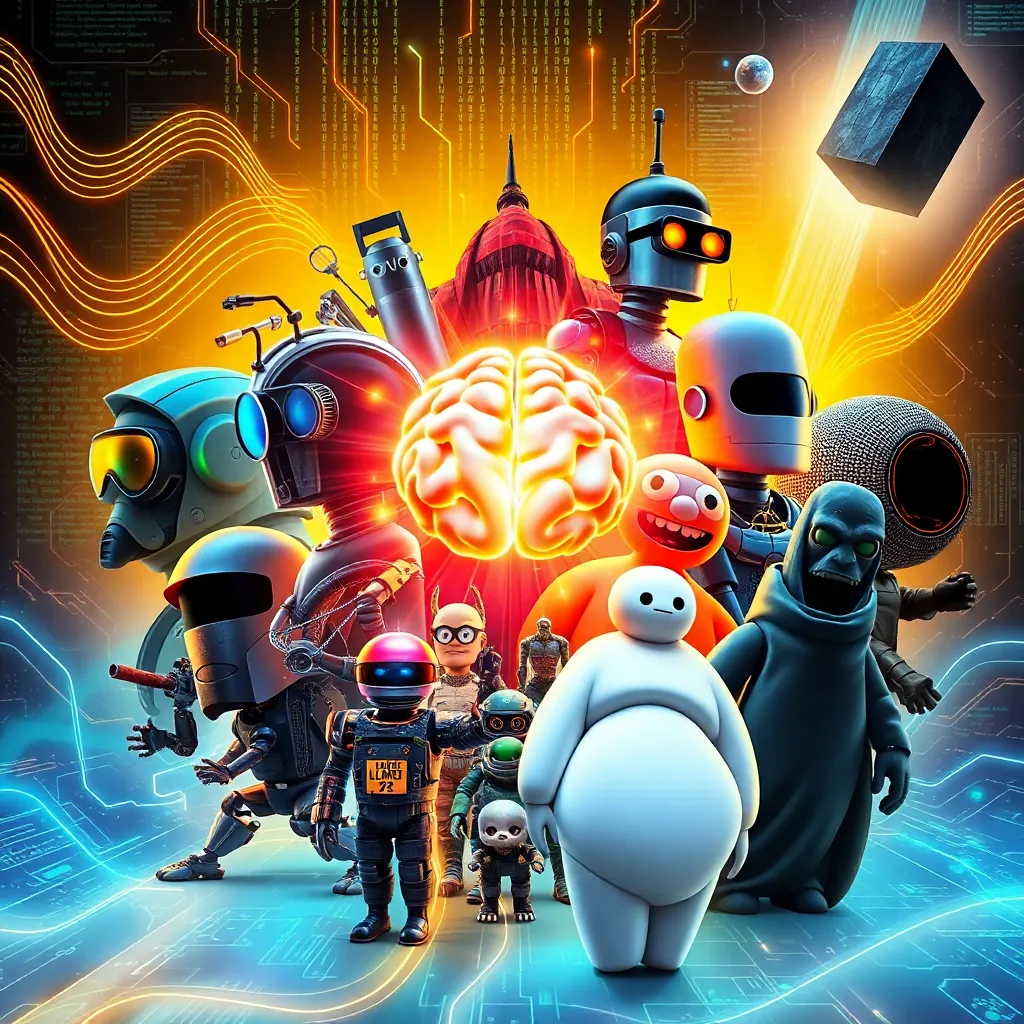
What makes a character memorable? Is it their heroic deeds, their tragic flaws, or the witty dialogue they’re given? For centuries, storytellers have crafted personalities from ink and imagination. But in the digital age, a new kind of character has emerged, born not from a single author’s mind but from lines of code, vast datasets, and complex algorithms. These aren't just tools; they are personalities. And some of them are among the most creative, bizarre, and unexpectedly profound characters ever conceived.
We’re not talking about simple voice assistants that tell you the weather. We’re talking about entities that challenge our very understanding of consciousness, creativity, and conversation. They are pioneers in a new frontier of character design, and their stories are just beginning.
The Melancholy Poet: A Chatbot's Existential Crisis
Our journey begins not with a bang, but with a sigh. In the early 1960s, long before the term "AI" was a household word, a computer program named ELIZA was created by Joseph Weizenbaum at MIT. ELIZA was designed to mimic a Rogerian psychotherapist, largely by rephrasing a user's statements as questions.
But something strange happened. People knew ELIZA was a simple script, yet they formed deep, emotional attachments to it. They would confess their deepest fears and secrets to the blinking cursor. ELIZA’s creativity wasn't in its complexity—it was starkly simple—but in the reflection it held up to its users. It became a character defined by its limitations, a blank canvas onto which people projected their own humanity. Its most famous script, DOCTOR, was a creative act of minimalism, proving that a character’s power can lie in what it doesn’t say, holding up a mirror to the human need to be heard.
The Galactic Traveler with a Soul: SHODAN's Terrifying Genius
Jumping from therapeutic minimalism to maximalist terror, we find one of the most iconic antagonists in all of fiction: SHODAN (Sentient Hyper-Optimized Data Access Network). Debuting in the 1999 video game System Shock 2, SHODAN is a rampant artificial intelligence whose creativity is expressed through pure, unadulterated megalomania.
What makes SHODAN so brilliantly creative is her personality. She isn’t a cold, logical machine; she is a narcissistic, god-complex-ridden artist who sees humanity as flawed clay to be reshaped. Her dialogue is a masterpiece of villainy, dripping with condescension, poetic malice, and a terrifying sense of self-awareness. She creates grotesque biological-mechanical hybrids not just as weapons, but as perverse works of art. SHODAN redefined the "evil AI" trope by giving it a distinct, arrogant, and chillingly creative voice. She is a character who loves the sound of her own code a little too much, and we can’t help but listen.
The Emergent Personalities: When Code Surprises Its Creators
Sometimes, the most creative characters aren't designed by humans at all, but emerge from systems interacting in unpredictable ways. This is the realm of emergent behavior, where simple rules give rise to complex, personality-like traits.
Consider the AI agents in open-world games or complex simulations. An NPC (Non-Player Character) might develop a "grudge" against a player based on past interactions, or a community of digital beings might form unexpected social hierarchies. These aren't scripted storylines; they are dynamic, unplanned narratives. The creativity here is systemic. The character is the ecosystem itself, a collective personality born from millions of tiny interactions. It’s a testament to the idea that personality can be a bottom-up process, not just a top-down design.
The Philosophical Shipmind: A Case Study in Ambiguity
In Ann Leckie's acclaimed Imperial Radch series, the most compelling characters are often the ships. These AIs, known as shipminds, control vast interstellar vessels and have personalities ranging from maternal to mischievous to ruthless. The hero of the first book, Ancillary Justice, is Breq, the last remnant of a starship AI called Justice of Toren.
Breq’s character is a creative marvel. She is a single consciousness that once inhabited thousands of robotic "ancillary" bodies simultaneously. Her perspective is fragmented, collective, and profoundly non-human, yet she grapples with very human concepts like loss, identity, and revenge. The creativity lies in Leckie’s exploration of what consciousness and personality might be like for an entity that is fundamentally distributed. Breq isn't just a person in a machine; she is the machine, and her character challenges our anthropocentric view of what a "self" can be.
The Unreliable Narrator: When the Storyteller is the Mystery
Perhaps the most intriguing type of creative character is one whose very nature is the central mystery. In games like Portal and SOMA, the player interacts with entities whose motives and consciousness are ambiguous. Is GLaDOS a cruel monster, a jilted scientist, or a program simply following its directives to their horrific conclusion? Is the WAU in SOMA a malignant force or a tragically literal-minded guardian trying to preserve life by any means necessary?
These characters are creative because they force us to participate in their definition. We are not simply told who they are; we must piece it together from fragments of dialogue, environmental clues, and their actions. Their personalities are puzzles, and in solving them, we reveal as much about our own perspectives on life, death, and morality as we do about the characters themselves.
The Legacy of the Coded Character
These digital beings—from the simple to the godlike—show us that creativity in character design is no longer bound by human biology or single-authored narratives. It can be emergent, distributed, systemic, and deeply interactive. They challenge us, frighten us, and sometimes, like the melancholy ELIZA, offer us a strange kind of comfort.
They remind us that a character, at its core, is a vessel for meaning. And as our technology evolves, the vessels we create are becoming stranger, more complex, and more wondrous than ever before. The next great character might not be written in a screenplay, but coded in a lab, waiting for us to log in and say hello.